
In Defense of Taste
Why taste isn’t a demotion, but an act of creation.

I know there’s been a surge of writing about the role of “taste” in the age of AI, much of it coming from male technical types. I felt compelled to add to the conversation after reading a piece by Will Manidis arguing against taste. I wanted to offer a perspective from someone who worked in fashion, specifically in merchandising and buying as a in-house “taste-maker” of sorts, and who now builds consumer tech.
What I gleaned from his piece is that ‘taste’ emerged in the 18th century alongside modern art. Taste as he sees it, replaced patronage, turning humans from collaborators and creators into selectors. And in an AI world, reducing ourselves to “having taste” is a demotion of agency.
It’s an interesting argument. And I disagree. Not because the research isn’t compelling. Manidis is clearly bright and deeply embedded in the world of AI and investing. I disagree because his conclusion doesn’t translate well to 2026.
The cultural feedback loops of today are more democratized and participatory than at any point in history, just spend a week on TikTok—as both a viewer and poster. We’re not suffering from a lack of making. We’re overwhelmed by it. And when abundance explodes, interpretation becomes power.
In the fashion industry, there’s a reason merchandisers and buyers exist before going direct to consumer. There is a reason designers rarely operate in isolation. Because contextualization and interpreting culture is a skill. Anticipating what will resonate, before consensus forms is a skill.
To say taste is a demotion for humans fails to acknowledge that taste lives inside culture and culture has always been collaborative and iterative. Taste isn’t inferior, it’s a byproduct of culture. The existence of infinite output doesn’t eliminate the need for discernment. It intensifies it. Yes, taste is manufactured. So is culture. So is language. So is any society you subscribe to.
An overview on taste
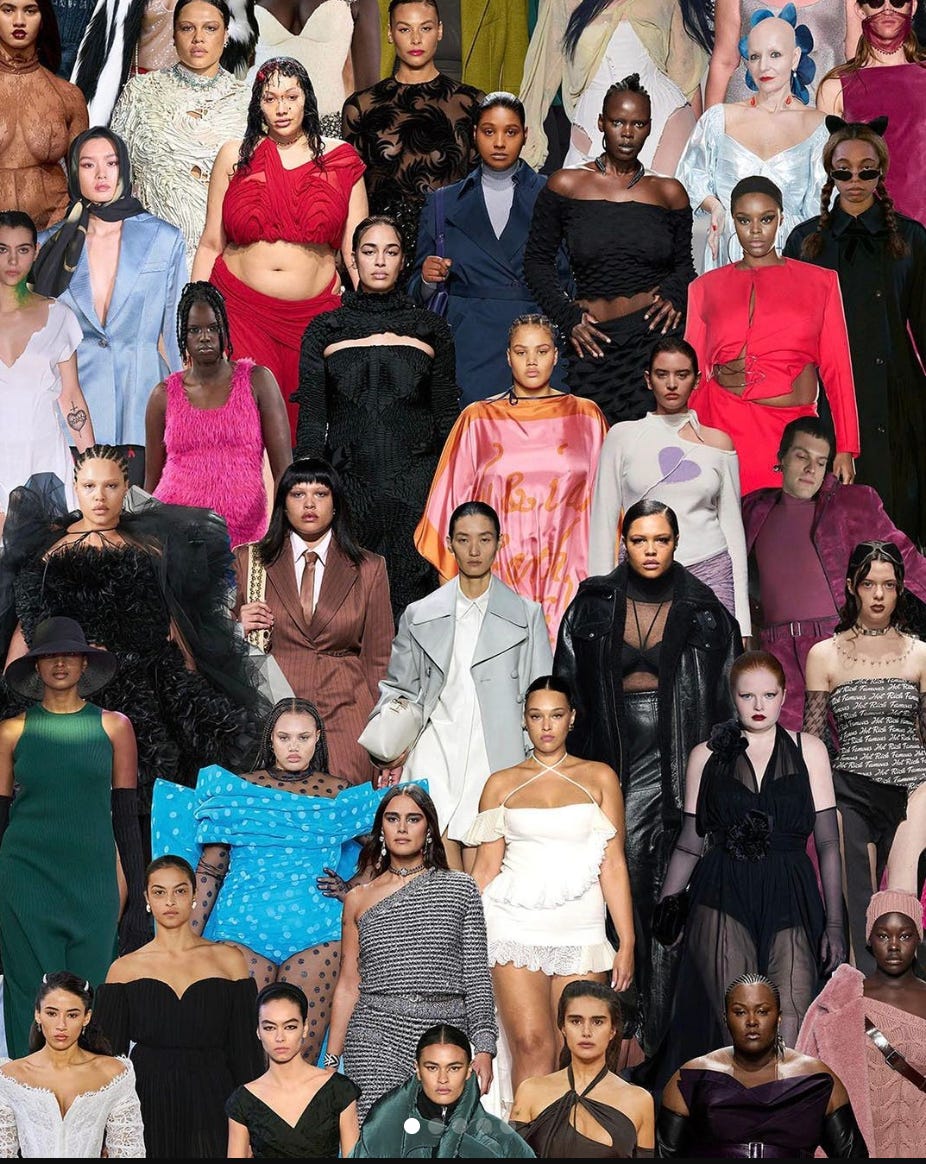
To keep it as basic as we can, the Oxford Dictionary defines taste as “the ability to discern what is of good quality or of a high aesthetic standard.” The key words here are ability, discernment, and judgment. Taste isn’t passive absorption. It is an evaluative faculty.
In my view, taste is interpretation paired with anticipation. It is the capacity to read cultural signals, both weak and strong, before they’re obvious. It’s the ability to sense when something aligns with the moment, when it feels premature, or when it has already peaked. AI predicts what is statistically likely based on past data. Taste, by contrast, is directional. It introduces what’s next. Statistical prediction can remix precedent, but it can’t independently decide when a silhouette feels exhausted, or when the emotional temperature of consumers shifted.
Prediction extrapolates from history. Taste makes an interpretive judgment about the present and a wager on the future. That wager is a creative act.
Patronage didn’t disappear. It Scaled.
TikTok functions as participatory patronage in real time. Creators post drafts, iterate from comments, launch products, and get feedback, instantly. Followers fund ideas with attention and purchase power. Collaboration now happens in comment sections and live streams rather than salons.
To go further, while influencers have held the “taste-maker” role for a while, there’s a clear hunger now for something else. The everyman perspective. Less polish. More behind the scenes, of everything. You see it on Substack. The requirements for a good TikTok. People aren’t just following for status anymore. They’re following point of view.
Selection Is a Skill
Professional taste requires empathy and contextual awareness. That applies across fashion and tech alike. Designers create. Buyers and merchandisers interpret and edit. Engineers build. Product Managers and UX designers discern what should exist and how it should feel. These roles exist separately because interpretation is its own competency.
The buyer role emerged alongside department stores because abundance required discernment. As supply expanded, so did the need for guidance. People historically picked up Vogue to understand what was “in.” Not because they were incapable of deciding, but because direction is often welcome. In a world where we make thousands of decisions a day, being guided, at least as a starting point, reduces friction. Interpretation doesn’t replace agency. It lightens the load.
AI clarifies the value of taste — good news for us humans
As AI tools streamline production and offload the mechanical parts of creation, we have more time to interpret, decide, and create with intention. Humans can smell AI from a mile away. They’re not neutral about it. They reject it. ChatGPT’s attempts at a social layer failed to gain traction. Meta’s push to insert AI-generated personalities and content into feeds royally flopped. When it comes to avatars, people would rather see them in gaming than in virtual try-on.
The more AI shows up as content, the more we want the opposite. Unscripted humans. Behind-the-scenes. Real life. TikTok didn’t invent that hunger, but it made it visible.
At the same time, the pressure to create has expanded. Personal brand isn’t niche anymore. It spans industries. Do you have a Substack? A TikTok with a perspective? Gemini and Chat GPT can tell us the answer to any question we have, yet increasingly we turn to humans for their two cents. Substack group chats. Reddit as a search engine.
We don’t just want information. We want interpretation. In a world where anything can be generated, taste becomes the filter, the direction. Not a demotion of agency, but a mechanism that drives creation.

This is exactly why I build yourcore - a platform for connecting with what you wear, why, and how it makes you feel. I’d love to see what you think of it if you’re open to it