
Fashion Tech Startups founded by Ex Stitch Fix People
How much they raised and where they are now

When I started working in the fashion industry in 2011, “fashion tech” wasn’t a coined term. Ecommerce made up less than 50% of most businesses, sexy direct-to-consumer brands like Glossier didn’t exist, and the mall was still king.
My first job out of college was at TJX, TJ Maxx and Marshalls, in their executive training program in Boston. It’s essentially an education in merchandising — how to plan and allocate inventory, source product, price it, negotiate with vendors, decide what to buy and how much of it, and then move it across 2,000+ stores. I learned a ton, and on the whole, I liked it.
Around this same time in 2012, I discovered and fell in love with a new, niche ecommerce-only brand called, Everlane. Its ten-SKU assortment, minimalist aesthetic, and fair price point felt magical to me. I wanted to work there so badly. I think I applied eight different times, wrote multiple letters to Michael Preysman (the founder), got far a few times in interviewing, but never landed the gig.
This was my signal that I wanted to work at the intersection of fashion and technology. While TJX remains a true store business (to the tune of $50B) I could see the opportunity to enhance fashion search and ecommerce beyond what leaders at Amazon, Google, and even Pinterest were focusing on.
Around 2014–15, it felt like my only options for work in this domain were Stitch Fix or Rent the Runway. I didn’t love Stitch Fix’s product (the clothing inventory), but I was intrigued by how strongly the concept was resonating. Rent the Runway was similar, but I had heard the work culture was tough. Still, I was dying to experience what it felt like to build in this space that sat between retail, culture, and technology.
Over the last three years, what was once a relatively open space has been flooded with venture capital—largely funneled into agents, avatars, and AI stylist platforms.
I was recently having a conversation with a former Stitch Fix merchant, and we started listing out the different startups that were born from former Stitch Fix people. It struck me how many of those same people have since gone on to raise significant capital in this space and made me curious of their results.
So I wanted to take a closer look at what they’ve built, how much they’ve raised, and where those businesses are today.
The Yes
The raise: $30M raised by Julie Bornstein, former COO of Stitch Fix, Chief Digital Officer at Sephora, and VP of Global Digital & E-commerce at Starbucks. The Series A was led by True Ventures ahead of its May 2020 launch. By early 2022, funding reached $40M, just before it was acquired by Pinterest for $87.6M.
Concept: An AI-powered shopping app designed to learn your style through continuous feedback and serve a personalized feed of products across hundreds of brands. The more you used it, the better it got.
Where are they now: Acquired by Pinterest in June 2022. The app was shut down, with the team and technology absorbed into Pinterest’s broader org and push toward shopping and discovery.
My thoughts: I had never heard of The Yes as a consumer, only in passing through fashion tech news and then in the context of the Pinterest acquisition. My assumption is that this type of ecommerce discovery wasn’t a core focus for Pinterest at the time, and The Yes helped push them further in that direction.
From what I’ve read in this Glamour article, the product improved over time. It started generic, but became more personalized the more users engaged. Easy to use, strong brand mix, and a more enjoyable discovery experience. But like many of these platforms, it required training, and early recommendations could feel off.
I think Bornstein built this product at the right time, and it was ultimately better suited to be absorbed by a behemoth like Pinterest than to stand alone, try to build its own brand universe and achieve global adoption.
Yaysay
The raise: Founded by Katherine Fitzgibbon, former Vice President at Stitch Fix & Lindsay Ferstandig former CMO of Athelta. Raised $10.3M led by Alex Taussig at Lightspeed Venture Partners, with participation from Kevin Hartz (Eventbrite, A* Star), Alexandra Wilkis Wilson (Gilt Groupe), Rati Sahi (The RealReal), Julie Bornstein (The Yes), Shira Suveyke (Shopbop, Outnet, Gilt Groupe), Gaurav Jain (Afore), Moshe Lifschitz (Shrug Capital), and Emily Heyward (Red Antler).
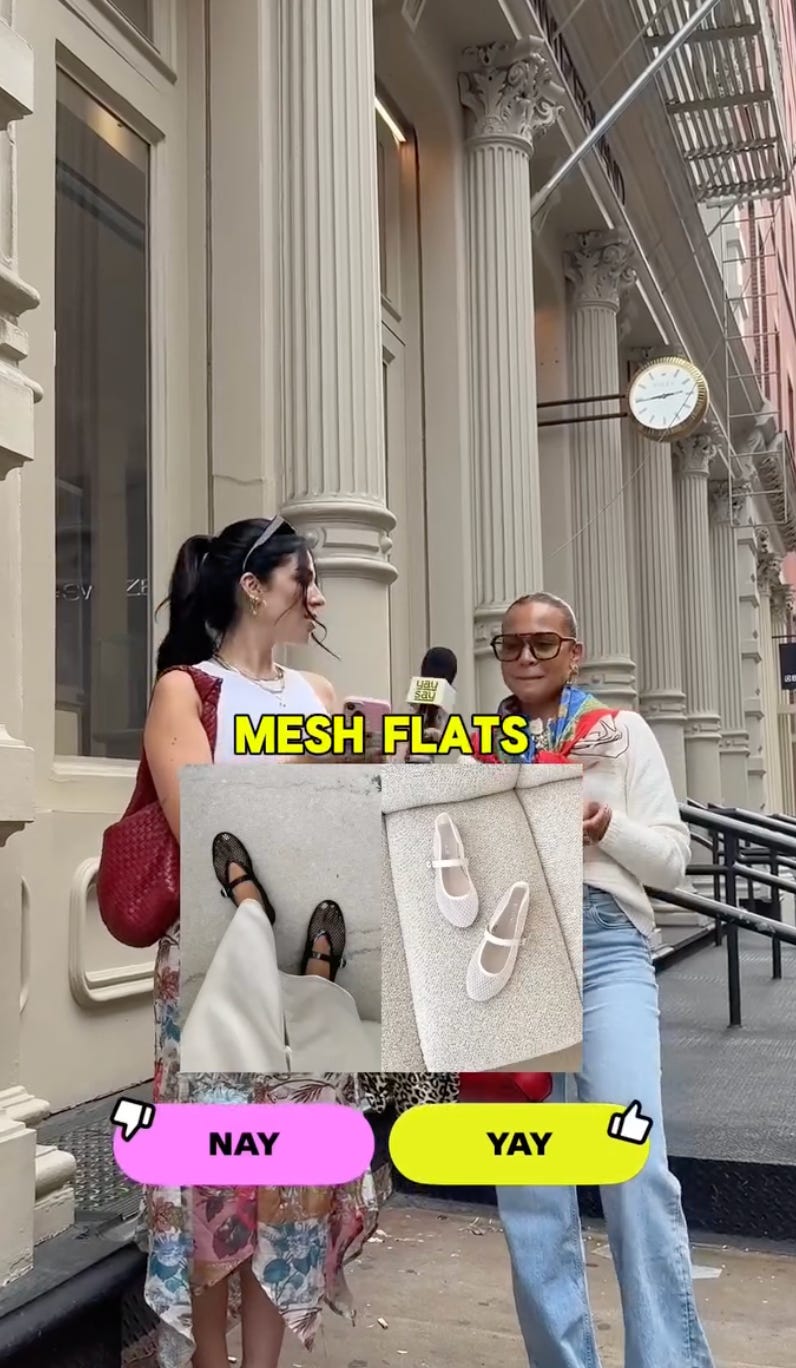
Concept: “A treasure hunt for luxury discount finds.” The best discovery tool out there said, Bethenny Frankel on TikTok, two years ago.
Where are they now: From their Instagram they are now Astridstyleai, your personal AI shopper and stylist.
My thoughts: I was actually a beta tester for Yaysay in 2023 after responding on a user testing platform. This was also in the earliest days of Cloud Closet, and I was trying to understand what others were building in the space. At the time, fashion tech felt quiet.
I met with a team member a few times and told them I thought the concept was strong and the product was well designed. They even gave me money to complete a checkout. But the issue for me was always the inventory. There was nothing I really wanted to buy. There were pieces like a Simkhai bag or Veronica Beard dress that were intriguing, but they felt like random purchases rather than things I actually needed or was seeking out. I ended up buying a pack of Hanky Panky underwear with my voucher.
It felt like they were trying to recreate the TJ Maxx treasure hunt digitally. But the product made it clear that swiping alone can’t replicate the IRL experience. The bones were there, but it lacked context and relied too heavily on having exceptional inventory. Real finds.
The RealReal could actually execute on this format well. With their inventory, it would feel like a more natural extension and a fun, low-effort way to browse.
Platforms like Depop or Vestiaire Collective could also lean into this. My friends at Thursday built something similar for thrifting. Three recent Carnegie Mellon graduates, built a super thoughtful product. They’re bootstrapped and trying to get it off the ground, but without strong networks, like those early at Stitch Fix, it’s difficult to get the attention or funding they likely deserve.
Daydream
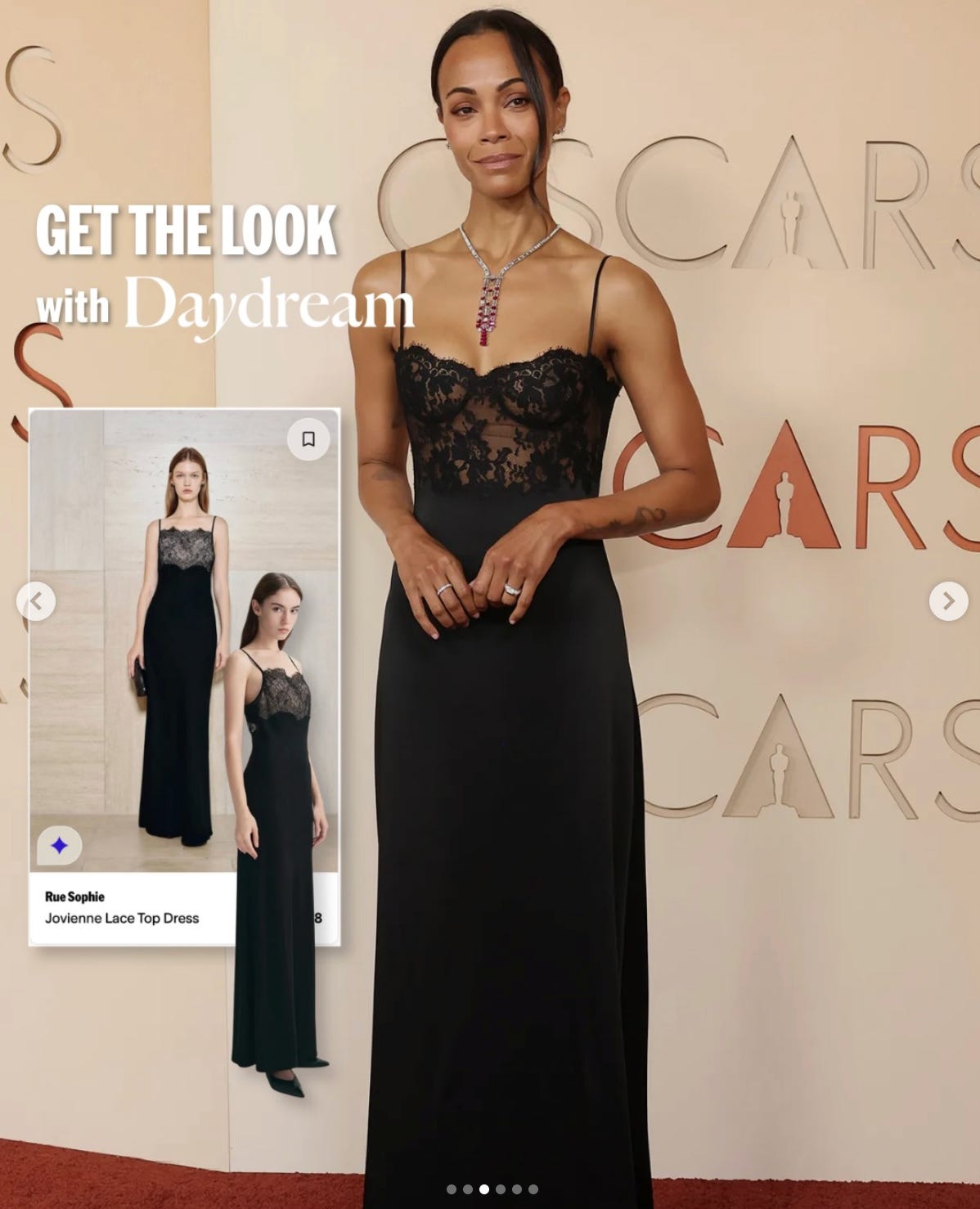
The raise: $50M co-led by Forerunner Ventures and Index Ventures, with participation from GV (Google Ventures) and True Ventures. Julie Bornstein (ex COO of Stitch Fix, Founder The Yes) and Lisa Green (The Yes, Conde Nast)
Concept: According to Daydream’s Instagram: “What are you shopping for? We’ll find it. 10K brands, no ads. AI for fashion people.”
My thoughts: Bornstein is right, it doesn’t make sense for Google to own fashion search. Search isn’t the future of fashion based ecommerce, discovery is. But Daydream, as it stands, still feels early in delivering true discovery.
Right now, fashion discovery is happening on Pinterest, TikTok, and Instagram, LTK for some, ShopMy for a certain sect. As these platforms scale, they get noisier and often present the same perfectly polished outputs. Pair that with growing influencer fatigue, and it’s no surprise fashion Substack has exploded: a new wave of voices that feel more 'normal’, with wardrobes that feel more attainable, i.e The Wardrobe Edit with Anna Newton.
Daydream’s approach centered around an agentic experience that reads dress codes and maps them to 10K brands, doesn’t yet feel compelling enough to fully resonate. It feels similar to Yaysay in that way, a bit diluted.
Given how quickly AI is evolving, building something like this today, six years after The Yes launched and exited, is a completely different story. The bar is higher, and consumer expectations have shifted. More importantly, “AI for fashion people” is hard to claim. It sounds right in theory, but it’s a narrow, more particular audience when it comes to new fashion tech adoption.
We explored a similar cohort early on, people deep in fashion, reading fashion Substack, actively posting fits on Instagram and TikTok, from stylists to creators, and when it comes to shopping online, they tend to be harder to convert. They already have systems they like, audiences and a strong sense of what they want to buy.

To wrap up
I actually tried to work at Daydream in early 2024. At the time, I was figuring out whether I could do Cloud Closet full time, which I didn’t think was possible without VC funding, and saw work at Daydream as an opportunity to potentially bring what we were building into their world. Bornstein replied to my InMail and connected me with her Head of Partnerships, who had worked with her at The Yes, but ultimately I was told I wasn’t a fit.
The good news is that rejection pushed me to go all in on Cloud Closet, sans funding. Leave my job in fintech, abandon a salary. It forced me to figure things out one scrappy bootstrapped step at a time, hustle, build brand partnerships (we now have access to 50K brands), and actually find our audience, starting with college students and even high schoolers, with presence in 60 countries.
While we haven’t raised anywhere close to what Bornstein and team have, and still have a long way to go product-wise with a limited tech budget, I think it’s made us stronger. We’re grassroots, closer to the user, and more intentional about building before taking outside capital.
The ironic part is, I never worked at Stitch Fix, but I did find myself coming back to Katrina Lake’s original insight, that widespread success in this category lives in the middle. Not just the fashion insider, or those living on the coasts, but the everyday person who cares about how they present and wants an easier way to get dressed.
And in 2026, if TikTok and Substack have taught us anything, it’s that people don’t want just better results from their search terms—they want context, connection and community. Not more influencers or avatars, but real insight from friends and other humans.
Follow along as we build Cloud Closet.